
Outdoor GFCI Trips After Rain: Check Before Paying
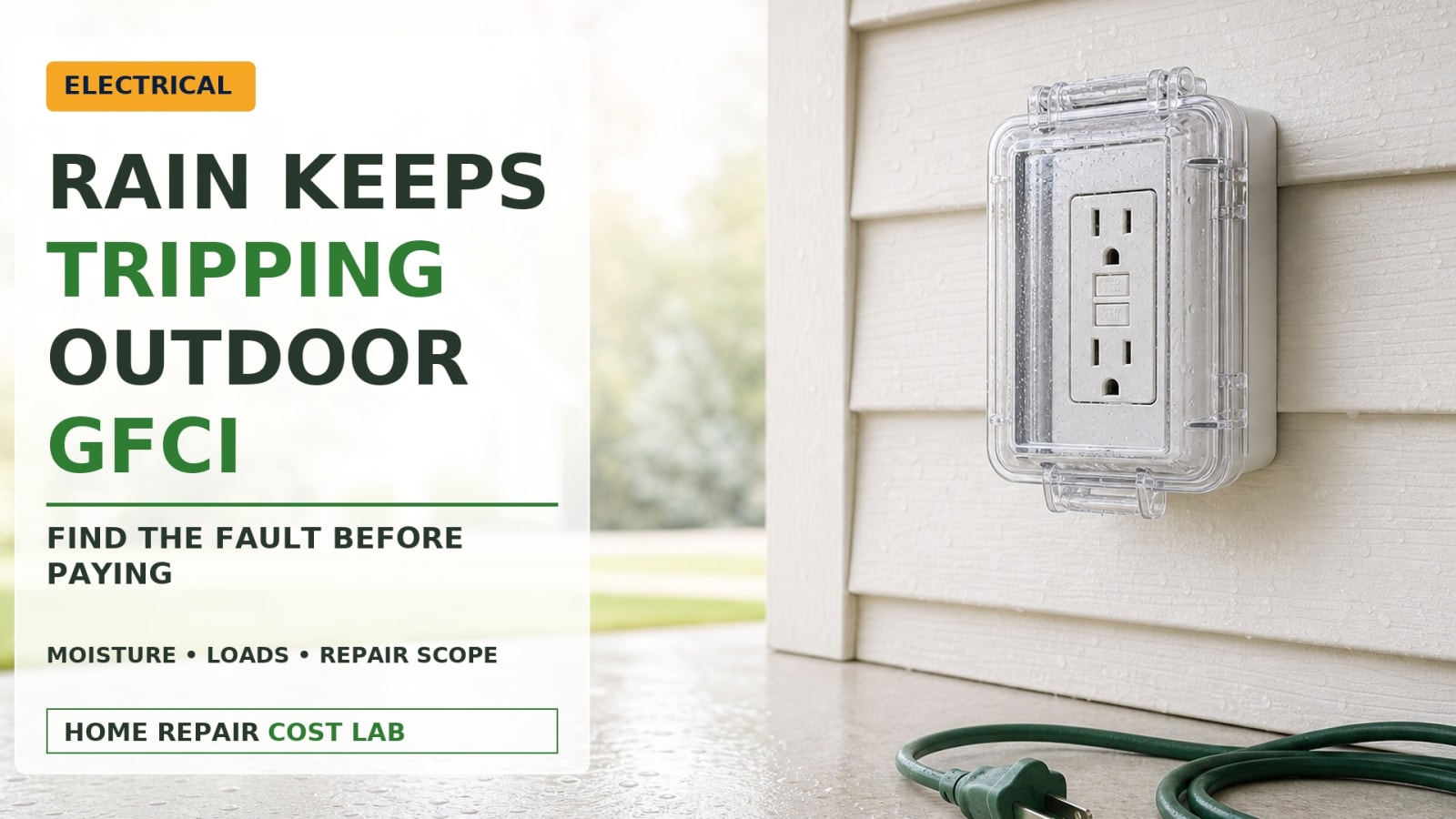
An outdoor GFCI that trips after rain is usually responding to a fault somewhere on the protected circuit, not automatically telling you that the visible receptacle is bad. Keep the circuit out of use, make only dry-ground observations, and have recurring or persistent trips diagnosed before approving a replacement.
That distinction affects both safety and cost. A new GFCI will not cure water entering a cover, a wet extension cord, a failing landscape transformer, or a downstream outlet that shares the same protection.
Treat the rain as a clue, not a diagnosis
A GFCI monitors the current on its circuit and opens when it detects an imbalance that can signal an unintended path to ground. Rain gives the electrician a useful pattern to investigate, but it does not identify the exact failed part.
Do not keep pressing RESET to see whether the problem has gone away. Never handle the outlet, cord, plug, or connected equipment when your hands, footing, or the equipment are wet. Visible smoke, sparking, crackling, heat, or a burning smell calls for immediate professional or emergency help as appropriate.
| What happened | Practical response | Use the circuit? |
|---|---|---|
| One trip after rain; it later resets normally | Make a note and watch for a repeat pattern | Only in fully dry conditions |
| Trips when one corded item is connected | Leave that item unplugged and arrange evaluation | Not with that item |
| Trips with accessible plug-in loads removed | Schedule electrical diagnosis | No |
| Will not reset after conditions are dry | Arrange qualified service before reuse | No |
| Broken cover, water exposure, scorch marks, or heat | Keep clear and seek prompt help | No |
The visible outlet may not be where the fault is
A receptacle-style GFCI can protect outlets farther downstream on the branch circuit. That is why an exterior outlet may be dead even though the tripped device is in a garage, on another side of the house, or at a different patio location. It is also why “nothing is plugged into this outlet” does not rule out every connected load.
Water getting past the cover
The U.S. Consumer Product Safety Commission advises weatherproof covers for outdoor outlets and says to keep unused covers closed. When a cord must stay connected in wet weather, a weatherproof-while-in-use cover is intended to protect the plug-and-outlet connection; a basic flat cover generally cannot do that job with a cord in place.
A cover can look closed and still leave a problem. Cracked plastic, a loose hinge, a damaged box, staining around the opening, or water entering behind the siding can all be worth documenting for the electrician. Do not remove the cover or receptacle to investigate.
A cord, transformer, or outdoor appliance
Outdoor-rated extension cords, holiday lights, landscape-light transformers, patio equipment, pond equipment, and yard tools are common items to put on the suspect list. A damaged plug or a cord lying in wet grass can be enough to create a repeatable rain-related problem.
If one accessible item appears tied to the trip, leave it disconnected. Moving it to a different outlet is not a safe way to prove it is the cause. The CPSC advises using only undamaged extension cords labeled for outdoor use with outdoor tools and appliances.
Another outlet or a fixed exterior load
A downstream receptacle may have a missing cover, a loose connection, or moisture exposure even when the first GFCI in the chain looks fine. Fixed equipment such as exterior lighting, a hardwired transformer, or a pump may require a professional to isolate safely. This is where a replacement-only quote can become a false economy.
The GFCI or its wiring
A GFCI that refuses to reset can have several causes, including no power reaching the device, an ongoing ground fault, wiring issues, or internal damage. Those causes require different repairs. A reset button that stays out is a reason to investigate, not a reliable diagnosis of a failed receptacle.
What to record without opening anything
Wait until you can stand on dry ground and reach the area without contact with wet electrical equipment. The goal is to preserve the evidence that disappears once the weather clears.
- Write down the trigger. Rainfall is only one possibility. Note wind-driven rain, sprinklers, pressure washing, snowmelt, or the first use of a particular outdoor item.
- List every affected location. Include garage receptacles, patio outlets, landscape lighting, exterior appliances, and equipment that lost power at the same time.
- Disconnect only plainly safe plug-in loads. Dry hands, dry plugs, and dry footing are the minimum boundary. Leave wet, damaged, inaccessible, or permanently connected equipment alone.
- Take a few exterior photos. Photograph the closed cover, cord routing, visible cracks, mounted transformers, staining, and model labels from a safe position.
- Describe the reset result once. Did it reset and remain on in dry conditions, trip right away, or refuse to reset? Do not turn repeated attempts into a test routine.
Save the weather trigger, affected locations, connected equipment, and dry-ground photos in one phone note before scheduling service; it gives the electrician a cleaner starting point.
Keep the electrical box closed. Do not pull the receptacle from the wall, probe it with a tester, alter line or load wiring, or defeat the GFCI. Homeowners who do not have the skills to follow proper wiring practices should use a qualified electrician for this work.
When a rain-linked trip should move up the list
A one-time trip that occurs after a storm and does not repeat once conditions are dry is not the same as a circuit that trips again with plug-in equipment removed. The first may justify monitoring and a nonemergency appointment if it happens again. The second needs diagnosis before the circuit goes back into regular use.
Do not use the circuit until qualified service is arranged if it will not reset in dry conditions, trips repeatedly, trips with accessible cord-and-plug loads disconnected, or has visible physical damage. The same applies when a likely suspect is fixed equipment that cannot be safely unplugged.
Dry weather can remove the symptom without repairing the entry point. Addressing a repeat pattern before the wetter part of the season is often easier than discovering the problem when outdoor lighting, tools, or seasonal equipment are needed.
Compare diagnosis scope before comparing prices
“Replace exterior GFCI” and “trace rain-related ground fault” are not competing names for the same job. The first may be the right repair after testing. The second is diagnostic work intended to find whether the GFCI, its enclosure, a connected load, a downstream location, or the wiring is actually responsible.
Ask for the written estimate to distinguish the work proposed:
- Diagnosis: identify the circuit, confirm the symptom, and evaluate available power and GFCI operation.
- Load isolation: assess corded equipment, transformers, pumps, lighting, or other connected exterior items that may be contributing.
- Downstream tracing: locate outlets or equipment protected by the same GFCI and inspect the relevant locations.
- Weatherproofing repair: correct a failed cover, enclosure, gasket, mounting condition, or other route for moisture.
- GFCI replacement: replace the protective device when the findings support that repair.
- Circuit repair: correct damaged cable, connections, or another wiring defect discovered during diagnosis.
There is no useful national shortcut price for this symptom because these scopes involve very different labor and materials. A modest receptacle replacement can be reasonable when the device is proven faulty. It is not an equivalent substitute for investigating a circuit that trips every time rain reaches a particular area.
Use this written-bid check before authorizing work
Ask the electrician to name the finding, not just the part being sold. A solid proposal should make it possible to compare two estimates even when neither is the lowest number.
- Which GFCI, circuit, and affected locations were identified?
- Which downstream receptacles, exterior loads, or connected equipment were inspected, tested, or excluded?
- What condition was found: failed device, water entry, damaged cord, wiring issue, or something else?
- Does the price include diagnosis, repair, or both?
- Which outdoor-rated cover, enclosure, receptacle, or other materials are included?
- What work would require approval beyond the stated price, such as tracing concealed wiring?
- Are service-call charges, labor, materials, permit handling, and warranty terms shown separately?
Local permitting and inspection rules vary by jurisdiction and by the repair found. Ask the electrician to explain what applies locally instead of assuming that a particular cover style or code edition governs every existing installation.
Put competing electrical estimates side by side and highlight what each one tests, repairs, excludes, and leaves unresolved; use this written quote checklist for the same scope-before-price comparison method.
Don’t pay to replace the wrong part
A GFCI trip after rain is doing something useful: it is interrupting a circuit that may have moisture exposure or another ground-fault condition. The homeowner’s job is limited but valuable—keep clear of wet equipment, preserve the pattern, and identify what else went dead.
Then approve a repair only after the written scope says what was found, which locations were checked, and why the proposed work should correct the rain-linked trip. That is a better basis for a repair decision than a reset button or a replacement guess.
Frequently Asked Questions
Can a garage GFCI control outdoor outlets?
Yes. A receptacle-style GFCI can protect outlets farther downstream on the same branch circuit, so the device that needs attention may be in a garage or another location. Record every outlet and exterior item that lost power rather than assuming the nearest dead outlet caused the trip.
Can sprinklers or pressure washing trip an outdoor GFCI?
They can provide a useful timing clue if water reaches a cord, plug, cover, enclosure, or damaged connection. Timing alone cannot identify the failed component. Treat a repeat pattern after irrigation or washing like a rain-related trip: stop using the affected circuit and arrange diagnosis.
Is it safe to reset an outdoor GFCI after rain stops?
Do not touch the outlet or equipment when your hands, footing, plugs, or nearby equipment are wet. Once conditions are fully dry and there is no visible damage, a normal reset may be attempted according to the manufacturer's instructions. If it will not reset, trips again, or has visible water or heat damage, leave it off and contact a qualified electrician.
Will replacing the outdoor GFCI stop rain-related trips?
Only when the GFCI itself is the failed component. Replacement will not correct moisture entering through a cover or box, a wet or damaged cord, a defective transformer or appliance, a downstream outlet problem, or damaged wiring. Ask what was tested before authorizing a replacement-only repair.
About this guide
Help U.S. homeowners estimate realistic project costs, compare repair versus replacement, audit contractor quotes, and account for season and region before committing money.
This page separates sourced facts from estimates and examples, states important limitations, and passes separate editorial and publishing checks before it is posted. It is general information, not individualized professional advice.
Sources reviewed: (checked 2026-09-10)


Comments
Post a Comment